Whistle came along in the spring of 2010. It was my third year of active rehabbing, and we had just moved into my parents’ home, after the passing of my father in February. Joe built a large (6′ x 4′ x 6′) aviary for Stars and Stripes, who loved having all the flight room.
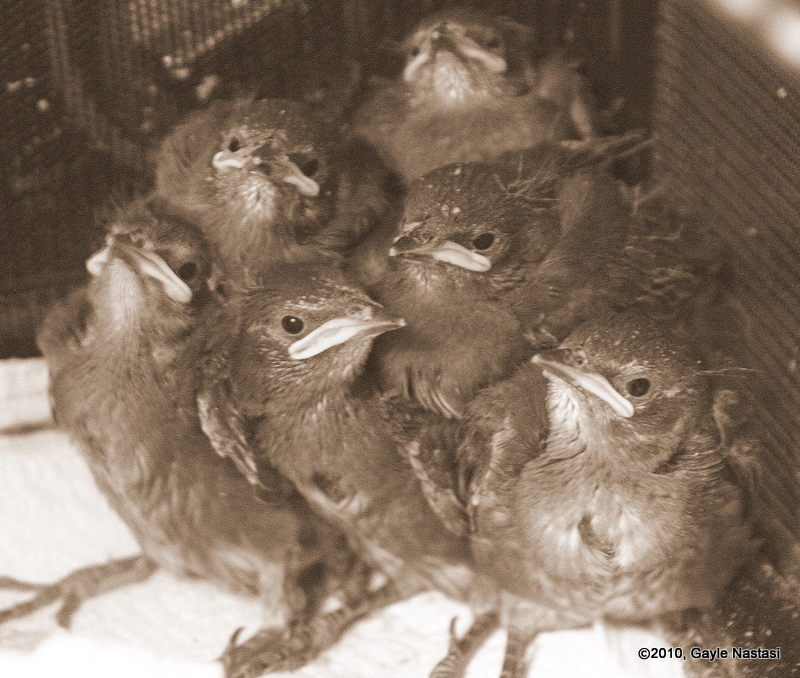
In May, a group of nestling Starlings, whose tree had been inadvertently felled, was brought to me along with a very young Grackle. I raised the seven babies together, doing my best to keep them apart from anything human-oriented. I was determined that they’d be safely released.
One little bird, despite my efforts, seemed a little too happy to see people. He (though I initially referred to him as “she” because of the sweet voice) would whistle and sing whenever I approached for feeding and cage care, and would usually make a beeline for me when he escaped from the cage. I did my best to ignore him and trusted to his bond with his siblings. Since he self-fed early, and seemed to be happy with the other birds, it did seem that he’d release without ado.
Once they were fully feathered and taking care of themselves, I moved them to the outdoor aviary. It’s rather tumbledown now, time having done its work on the old wood, but this cage actually came from the shut-down Catskill Game Farm. It was one of their outdoor bird display cages in its youth.
They all seemed to adapt very well to the outdoors, and respond encouragingly to the sights and sounds of wild birds around them. Once I was sure they’d acclimated, I opened the cage. The Grackle (whom we thought of as “Chuck” because of the sounds he made) was the first to take off. Then, one at a time, five of the six Starlings joined him in the great outdoors. Although the many birds I’ve released here haven’t stuck around, I do suspect that the pair of Starlings that nest in our soffit every year are descendants of Whistle’s siblings.
All were gone but one. The little “whistle bird” refused to leave. I was still barely mobile at this point, after the autoimmune attack that hospitalized me in 2008. It was late at night when it was obvious that this little bird was frantically trying to batter himself against the sides of the cage. Worried that once I got in the cage I might not get back out, I asked my son, Devon, for help. He caught the bird, and we brought him back into the house.
He escaped as we tried to put him back in the baby cage, flew to my shoulder, and started to sing at the top of his happy little lungs.
For sixteen years, Whistle sang, talked, and took his special place as part of the family. Due to my efforts to keep him from imprinting, he was never quite as tame as Stars and Stripes, but he still enjoyed human company and responded to our connection as an obvious pet. His vocabulary was more of the mimicking variety than like Stars’ ability to truly communicate, but he had quite a repertoire of phrases. One of my favorites was when he would ask the girls, “Who’s your mommy, baby bird?” and then give a wolf-whistle. Our little feathered Cassanova.
We tried putting him in the big aviary with the girls, but he decided to be a bully, and began to harass them badly. Joe’s carpentry skills once again were employed, and a barrier was built that divided the cage. Whistle lived in the smaller third, and the two girls had the larger area. The divider was made of hardware cloth, so they could all see one another and interact. After we lost Stars to that terrible wing tumor, Stripes was alone in the big cage for some time. Around the same time that she began to have geriatric problems that prevented her from flying and landing safely, Whistle also developed a malady that caused us serious concern.
He began to have occasional seizures. I was told, after the first episode, that he “wouldn’t live through the night.” That was about three years before he finally left us. After he’d fallen off a high perch once or twice, however, he became fearful of being up high, and chose to live on the cage floor. We set up special accommodations for him and, once Stripes’ situation developed to the point that she was no longer safe, she moved into his side of the cage with him. Having been together, despite the divider, for so long, they were quickly inseparable.
By this time we also had Jingle and Tidbit, two more “foster fails,” as the dog and cat rescue people say. They were in a large, but far from large enough, flight cage in the laundry room. Since the two old birds didn’t need the space anymore, we moved them into the large part of the aviary.
As those who follow me already know, ten days after we lost sweet Stripes (who would have been 18 in the spring) so suddenly, my Whistle bird followed her through the veil. Although his seizures, after the first month or so, had pretty much faded out, he suddenly had a very bad one. He seemed, at first, to be recovering. His ability to stay upright stabilized, he was eating again, and I thought he would pull through. However, he must have had another, perhaps even a stroke, during the night. The next day, I found him lying on his side, barely able to raise his head. I made him comfortable and safe in a box lined with soft paper towels, and stayed with him, talking to him, and stroking him. After several hours, while I was singing him the “Mommy’s Baby Bird” song, he stretched out his legs, fluttered his wings, and was gone.
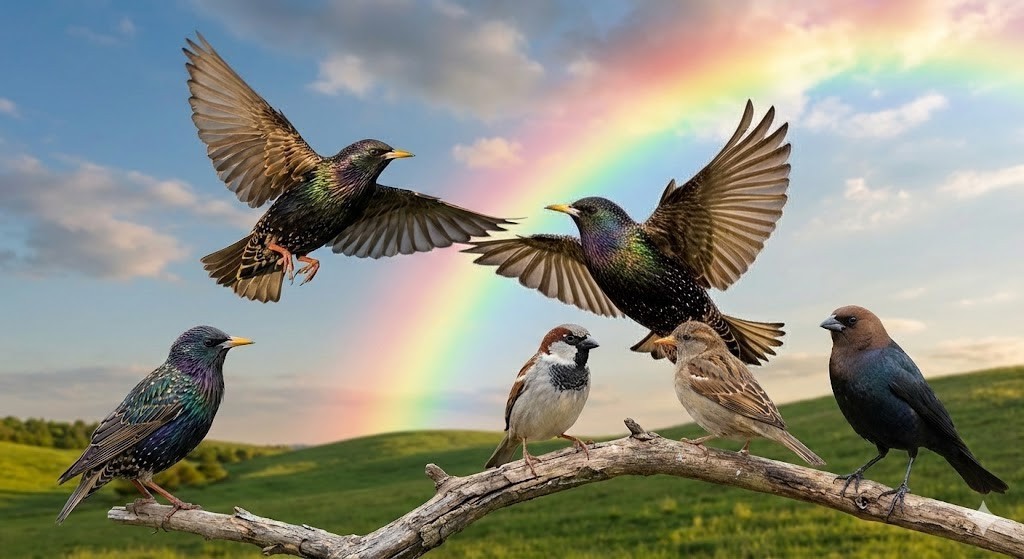
We’re down to two. Once or twice upon a time, there were Starlings: Stars and Stripes and Whistle. Sparrows French Fry and Tater Tot. Sweet Cowbird Pitt (who, honestly, I was never quite sure was supposed to be here, but he had a beak deformity that meant he’d never survive in the wild, so he also stayed … for sixteen years). It’s just Jingle and Tidbit now. Jingle makes enough noise for a whole flock, but still … the house seems so quiet.
I miss you, my Whistle Bird. You made a hard choice all those years ago, and although it wasn’t the option I’d selected for you at the time, I’m so glad you stayed.
And will stay, forever in my heart.
 Gazehound's